There are moments on an African safari that you expect to remember.
Your first elephant.
Your first giraffe.
Your first leopard.
But then there is a moment you cannot really prepare for:
The first time you hear a lion roar.
You may not even see the lion.
You may be sitting around a campfire after dinner, lying in your tent, or driving through the bush just before sunrise when the sound suddenly rolls across the darkness.
A deep, powerful roar.
And for a moment, everything feels different.

You Hear It Before You See It
That’s what makes a lion’s roar so unforgettable.
You can be surrounded by darkness and have absolutely no idea where the lion is.
Then you hear it.
Once.
Then again.
Perhaps another lion answers somewhere in the distance.
Suddenly, the African bush doesn’t feel empty anymore.
You realize that somewhere beyond the trees and grass, a powerful wild animal is moving through the same landscape.
And you are simply a visitor in its world.
What Does a Lion’s Roar Actually Mean?
A lion’s roar isn’t simply an animal “being angry.”
Roaring is an important form of communication.
Lions may roar to communicate their location, maintain contact with members of their pride, advertise their presence to other lions and reinforce territorial boundaries.
A roar can travel surprisingly far across open landscapes.
This means a lion can communicate with other lions without physically seeing them.

Why Does the Roar Feel So Powerful?
Part of the reason is the lion’s anatomy.
Lions have specialized vocal structures that allow them to produce extremely loud, low-frequency sounds.
The result isn’t anything like hearing a domestic cat.
It is deeper.
It is heavier.
And when the sound carries across an open savannah at night, the landscape seems to amplify the experience.
You don’t just hear the roar.
You feel it.
Imagine Hearing It at Your Safari Camp
It’s late.
Dinner is finished.
The sky is almost completely dark.
You’re sitting outside your tent listening to insects and distant nighttime sounds.
Then—
ROAR.
Everyone stops talking.
Someone looks at the guide.
Another person whispers:
“Was that a lion?”
Then it happens again.
Only this time it sounds closer.
Your guide smiles.
You’ve just experienced one of the things people travel thousands of kilometres to experience.

The Bush Sounds Different at Night
During the day, the African savannah can feel enormous and peaceful.
Birds are calling.
Insects are buzzing.
Animals are grazing.
Then darkness arrives.
The soundtrack changes.
You might hear:
- Hyenas calling
- Hippos grunting
- Owls calling
- Crickets and insects
- Nightjars
- Distant animals moving through vegetation
- And sometimes, lions roaring
The darkness makes every sound more noticeable.
You can’t see what produced the noise.
You have to listen.
Why Do Lions Roar Mostly at Night?
Lions can roar at different times of day, but roaring is particularly noticeable during the evening and nighttime.
Cooler temperatures can also make nighttime activity more comfortable for lions.
For visitors, however, nighttime is when the experience becomes especially atmospheric.
The sun has disappeared.
The bush is almost completely dark.
And sound carries through the landscape.
That’s when a distant roar can feel enormous.

Does a Lion’s Roar Mean It’s Coming for You?
No.
Hearing a lion roar near a safari camp does not automatically mean the lion is approaching people.
Lions roar primarily for communication with other lions.
Well-managed safari camps also have procedures designed to keep guests safe, and visitors should follow their guides’ instructions about moving around camp after dark.
That is one reason you should never wander away from camp alone at night.
The bush is home to wild animals, and nighttime is when many of them become active.
You Might Never See the Lion
And strangely enough, that can make the experience even more memorable.
You may spend an entire game drive searching for the source of a roar.
You check the trees.
You scan the grass.
You look through your binoculars.
Nothing.
Then your guide points toward a distant ridge.
A few minutes later, you finally see it.
A small shape against the horizon.
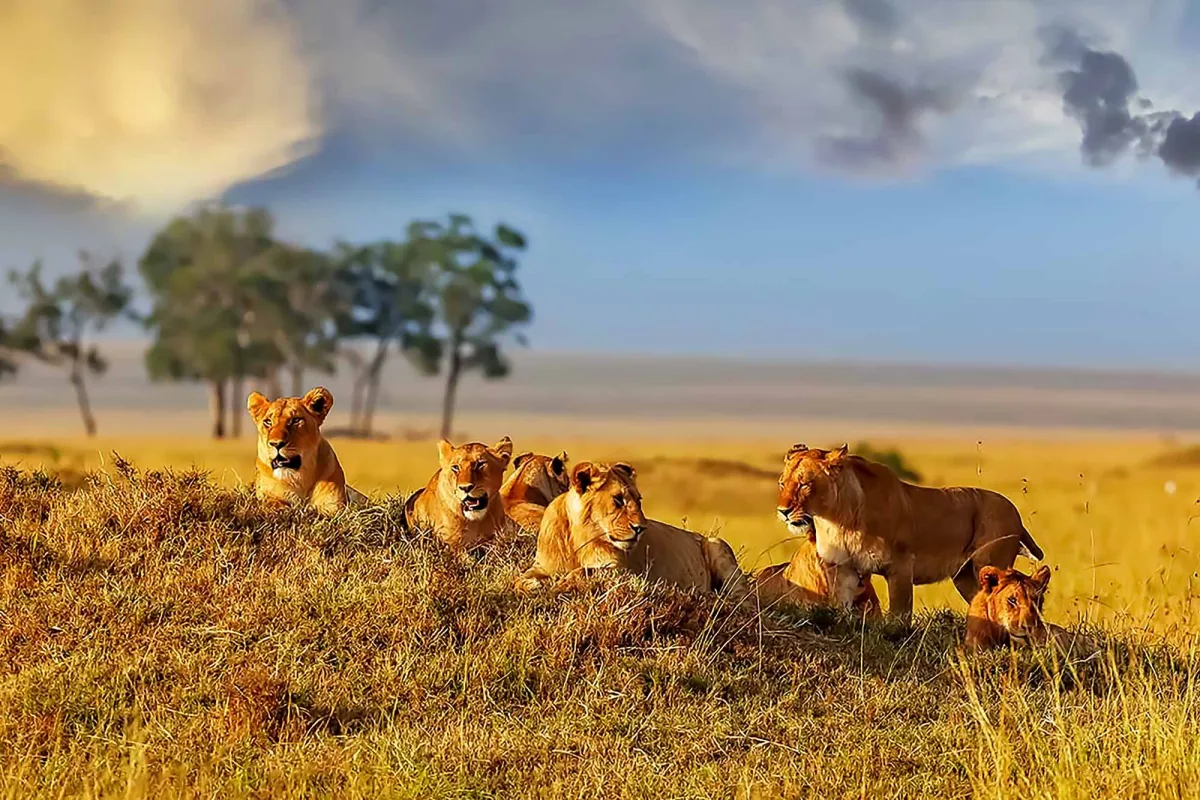
A lion.
Suddenly the sound you’ve been hearing has a face.

The First Roar Is Different From Seeing a Lion
When you see a lion lying beneath a tree, you are looking at an animal.
When you hear its roar echo across the bush, you experience the presence of the animal before you see it.
That’s a completely different feeling.
The sound makes you realize how much is happening beyond what your eyes can see.
The grass isn’t empty.
The darkness isn’t empty.
The landscape is alive.
And Then You Hear Another One
Sometimes the most incredible moment isn’t a single roar.
It is hearing lions communicate across the landscape.
One lion roars.
A second responds.
Then another sound comes from somewhere farther away.
For a few minutes, the bush becomes a conversation.
You may not understand what they’re saying.
But you know the message is being carried across the night.

This Is Why Safari Is More Than Wildlife Sightings
A safari isn’t only about collecting photographs.
It’s about experiences that engage all your senses.
The smell of rain on dry earth.
The sound of birds waking before sunrise.
The sight of elephants walking across the plains.
The feeling of cool morning air coming through the open safari vehicle.
And then, one night:
A lion roars.
You may remember the photograph you took.
But you’ll probably remember the sound even more.
Your First African Lion Roar
Maybe you’ll hear it in the Serengeti.
Maybe in the Masai Mara.
Maybe in Queen Elizabeth National Park.
Maybe somewhere far from the nearest city, sitting beside a safari camp with nothing but darkness surrounding you.
You won’t know exactly when it will happen.
And that’s part of the magic.
Because the best safari moments aren’t always the ones you schedule.
Sometimes they simply find you.
The first time you hear a lion roar in the African bush, you don’t just hear wildlife.
You hear Africa.