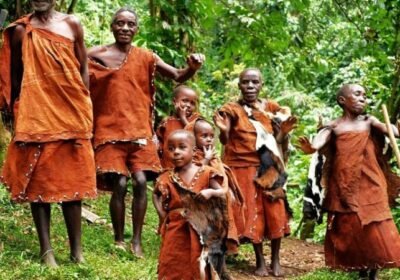
The Batwa people, sometimes referred to as Twa, are among the oldest...
When you travel with Bashem Safaris, part of every journey goes toward the people who once called these forests home — the Batwa of Bwindi.
The Batwa — sometimes called the Twa — are among the oldest surviving peoples in all of Central Africa. For more than 60,000 years, they called the equatorial forests of the Great Lakes region home. Hunters and gatherers, healers and storytellers, they were known as the Keepers of the Forest. They knew every plant, every path, every animal. They shared the forest with the mountain gorillas long before the world knew gorillas existed.
Then, in 1991, Uganda established Bwindi Impenetrable National Park to protect those same gorillas. And the Batwa — with no land titles, no legal recognition, and no compensation — were evicted. Overnight, a people who had lived in harmony with that forest for thousands of years had nowhere to go.
Today, approximately 6,000 to 7,000 Batwa live scattered across southwestern Uganda — in Kisoro, Kabale, Kanungu, and beyond — navigating poverty, limited education, poor healthcare, and ongoing social exclusion. They gave up their home so the world could have its gorillas. Most of the world has never said thank you.
Emmanuel Bashitsi, the founder of Bashem Safaris, was born and raised in Kisoro — the same region where many Batwa communities now live.
He did not read about the Batwa in a report. He grew up alongside them. He watched them navigate a world that had pushed them to the edge. And when he built Bashem Safaris, he made a quiet, firm decision: this company would not just show people the beauty of Uganda. It would also take responsibility for the people the world had left behind.
This is not a campaign. This is personal.
For the past five years, Bashem Safaris has been actively working with Batwa communities in Kigezi. Here is what that looks like on the ground.
Bashem has directly supported 50 Batwa students through primary, secondary, and university-level education — covering school fees, supplies, and essentials. Education is the long road out of poverty. We are committed to walking it with these families.
When families are hungry, nothing else matters. Bashem has organised food distribution drives providing staple foods to Batwa households across Kisoro and surrounding districts. Short-term relief — but it keeps families alive while longer-term change takes root.
Through partnerships with medical professionals, Bashem supports health outreach in Batwa communities — bringing care to people who would otherwise go without.
The next chapter of Bashem's work is about empowerment, not dependence. Through the Bashem-Batwa Development Program, we are helping 500 Batwa households develop their own food production — growing beans, sweet potatoes, and sorghum — while training women and youth in weaving, tailoring, and craft work. The goal is champions: people who become examples and teachers for the next family, and the next.
When you book a safari with Bashem Safaris, you are not just choosing a trip. A portion of every booking is directed toward Batwa community support — education, food, health, and skills training.
You do not have to do anything extra. Simply choosing to travel with a company that chooses to give back is enough.
Some guests go further — visiting the Batwa community as part of their safari, making additional contributions, or partnering with us on the development program directly. Every level of involvement matters.
Not every supporter needs to book a safari. If this story has moved you and you want to contribute directly — whether toward education, food support, health outreach, or the agriculture program — we would love to hear from you.
We are not a large NGO. We are a small team working directly in the community. Whatever you give goes straight to the ground.
Stories, updates, and news from the field — because this work never stops, and neither do we.
We believe travel should leave places better than you found them. Come travel with us.
WhatsApp us